
Are you frustrated by the lack of control and innovation with the traditional white label solutions? Operators today face poor customization, slow update rollouts, and lookalike products that hurt growth. These outdated solutions can’t simply keep up with the latest operator requirements. But you don’t have to settle for less!
This blog takes you through the traditional white label failures, helping you choose the right, smart, and flexible alternatives that turn your iGaming brand into a true success.
White label solutions are pre-built solutions or services that a company offers to its clients with client-specific rebranding. This means that the clients do not need to invest in the development and manufacturing, but in the pre-built, on-demand custom platforms, saving initial costs.
The white label solutions work in the following ways –
- Development: A provider company develops a generic platform or service.
- Rebranding: A company buys and rebrands the platform or service, like changing the logo or branding.
- Customization: Keeping the core product the same, the company makes certain customizations that their players or users would like, such as appearance, marketing, features, etc.
10 Critical Flaws Killing Traditional White Label Solutions
While traditional white label solutions may benefit a couple of operators, modern operators will face a lot of white label solution drawbacks. Here are some of them to take into consideration.
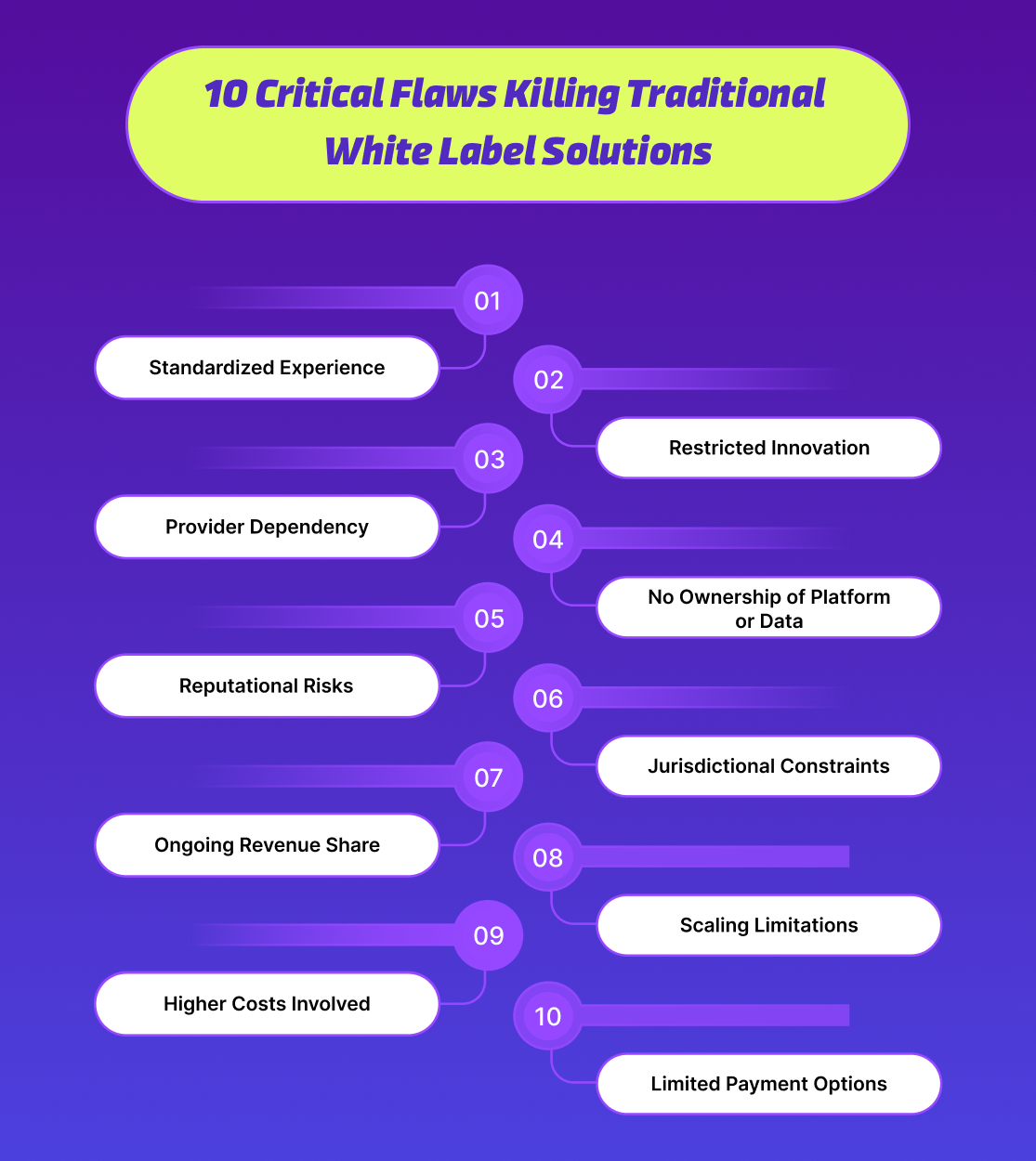
Standardized Experience
The platform’s core is the same for all operators. This makes it hard for a brand to stand out. Competitors are using the same white-label providers, and if you are doing so, you’re no different.
Restricted Innovation
Operators cannot easily introduce unique features or improve the user experience. This makes it hard to meet specific market demands or incorporate customer feedback. All changes depend on the provider’s development queue. These changes are unlikely to be prioritized.
Provider Dependency
Operators depend on their provider for technical support, maintenance, updates, and game selection. This means operators have little control over the platform’s development or how quickly issues are resolved, creating white label dependency issues.
No Ownership of Platform or Data
The white label provider controls the software which is one of the biggest white label casino problems. They also own the player data. This can limit an operator’s platform evolution, making switching providers difficult. The provider gains significant business leverage.
Reputational Risks
Your brand’s name is linked to the platform provider. Problems with the provider can hurt your business. This includes technical, security, or legal issues.
Jurisdictional Constraints
Operators face restrictions. They are limited by the white label provider’s gaming license. This can stop them from growing into new markets. A new license might be needed for each new area, cancelling out the benefit of using the provider’s license.
Ongoing Revenue Share
White label solutions seem cheap at first, as it does not include developmental costs. But you pay a part of your earnings and monthly fees forever. This cuts into your profits over time.
Scaling Limitations
Every business needs to scale with growing users and databases. Shared infrastructure limits growth. It can’t handle high traffic well. This causes slow loading and a bad user experience.
Higher Costs Involved
Growing operations find revenue-sharing white label solutions costly. Many transition to turnkey and custom solutions owing to these white label casino problems. This gives them more control. It also reduces long-term expenses.
Limited Payment Options
Operators can’t pick and integrate their own payment systems. They are stuck with what the provider offers, making white label casino disadvantages much more prominent.
White Label Solution Alternatives for Forward-thinking Operators
Are you frustrated with white label limitations iGaming and looking for some alternatives that would help you grow your business smoothly? Turnkey is your top pick. Let’s see how.
Turnkey iGaming Solutions
A turnkey iGaming solution is a ready-to-use platform that lets operators launch online casinos or sportsbooks quickly without building from scratch. It includes software, games, payment processing, and back-office tools, all integrated for smooth operation.
Benefits of Turnkey Solution
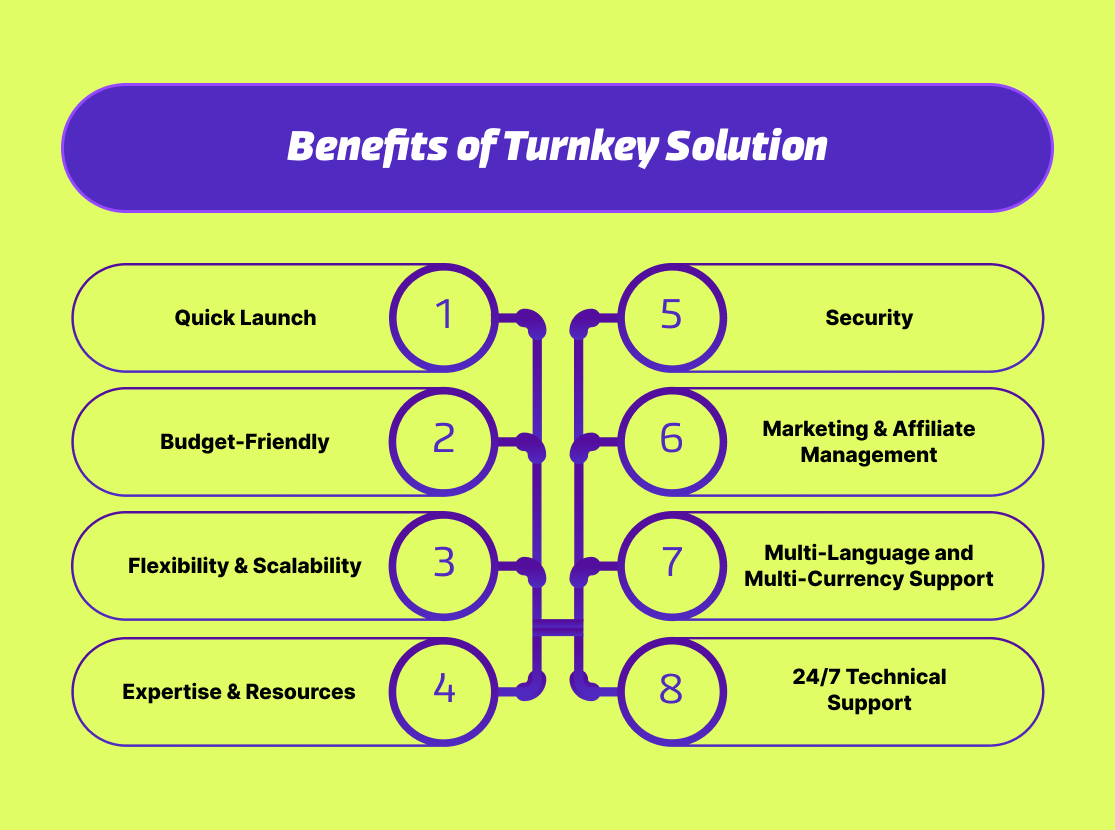
Quick Launch
Turnkey solutions let you go live faster with pre-built modules and integrations without the hassle of development from scratch.
Budget-Friendly
Turnkey solutions often come with a fixed budget, which provides cost predictability and helps prevent unexpected expenses and cost overruns.
Flexibility & Scalability
Turnkey solutions can be customized to meet specific needs and allow businesses to adapt and scale their operations effectively.
Expertise & Resources
You gain access to the provider’s expertise, technology, 24/7 support, and resources, allowing you to concentrate on your core business activities.
Complete Control
Turnkey solutions let you use your own license and brand. This gives you full control over decisions and profits.
Vast Game Library Access
Turnkey packages offer many games from top developers. Players get a diverse experience from the start.
Robust Security Features
A reliable turnkey solution has strong security. This includes encryption and DDoS protection. It keeps player data and money safe.
Built-in Compliance Tools
Turnkey providers help with licenses. They have features for checking customer identity (KYC). They also help prevent money laundering (AML) and promote responsible gaming, lowering legal risks.
Other Alternatives
Other iGaming solutions that beat the traditional white label issues include –
Custom Software Development
For operators with the vision and resources, a custom-built platform provides unmatched flexibility, ensuring the product perfectly aligns with its target audience or market niche.
Modular API & Game Aggregation
This approach is great for businesses that already exist or want to combine different options. Operators can use a strong API to add various games and features to their own platform or one from another company.
Specialized CRM & Gamification Platforms
Operators can add specialized platforms for CRM and gamification to improve player engagement and loyalty, increasing profit without changing their main white-label system.
Traditional White Label Solutions Vs Modern Turnkey Solutions: One That Makes More Sense
Parameters
Traditional White Label Solutions
Modern Turnkey Solutions
Revenue Model
15–30% ongoing revenue share + monthly fees
One-time setup fee with low revenue sharing
Customization Control
Limited to basic branding (logos, colors)
Extensive customization of all platform elements
Operational Control
Provider manages backend, payments, and compliance
Full control over operations, payments, and systems
Launch Duration
2–4 weeks (faster launch)
1–4 months (due to licensing and customization)
Licensing Requirements
Operates under the provider’s master license
Operators must obtain independent licenses
3rd Party Integrations
Restricted to pre-approved solutions
Complete freedom to integrate any providers
Financial Management
Provider manages all transactions
Operators have direct control over all financial operations
Feature Development
Cannot develop new features independently
Full flexibility for feature innovation
Geographic Expansion
Limited by the provider’s licensing jurisdictions
Freedom to expand into any licensed markets
Long-term Costs
Higher due to ongoing revenue share
Lower revenue share & operational costs after initial investment
Scalability
Limited by the provider’s infrastructure
Unlimited scalability with proper planning
Brand Differentiation
Generic platform shared with others
Unique platform tailored to brand identity
Exit Strategy
Difficult migration, might lose everything
Full platform portability and independence
| Parameters | Traditional White Label Solutions | Modern Turnkey Solutions |
|---|---|---|
| Revenue Model | 15–30% ongoing revenue share + monthly fees | One-time setup fee with low revenue sharing |
| Customization Control | Limited to basic branding (logos, colors) | Extensive customization of all platform elements |
| Operational Control | Provider manages backend, payments, and compliance | Full control over operations, payments, and systems |
| Launch Duration | 2–4 weeks (faster launch) | 1–4 months (due to licensing and customization) |
| Licensing Requirements | Operates under the provider’s master license | Operators must obtain independent licenses |
| 3rd Party Integrations | Restricted to pre-approved solutions | Complete freedom to integrate any providers |
| Financial Management | Provider manages all transactions | Operators have direct control over all financial operations |
| Feature Development | Cannot develop new features independently | Full flexibility for feature innovation |
| Geographic Expansion | Limited by the provider’s licensing jurisdictions | Freedom to expand into any licensed markets |
| Long-term Costs | Higher due to ongoing revenue share | Lower revenue share & operational costs after initial investment |
| Scalability | Limited by the provider’s infrastructure | Unlimited scalability with proper planning |
| Brand Differentiation | Generic platform shared with others | Unique platform tailored to brand identity |
| Exit Strategy | Difficult migration, might lose everything | Full platform portability and independence |
GammaPlus: Next-Gen Turnkey iGaming Platform for Modern iGaming Operators
GammaPlus is a next-generation turnkey iGaming platform for modern operators who need speed and reliability. We provide ready-made casino and sportsbook modules with fast integrations. Teams receive hands-on operational support to launch without heavy engineering.
Our modular design lets operators add custom features without rebuilding core systems. Built on GammaStack’s 14+ years of hands-on expertise, GammaPlus prioritizes uptime, compliance, and fast time-to-market.
Frequently Asked Questions (FAQs)
What exactly is a white label iGaming solution?
A white label iGaming solution is a pre-built, ready-to-launch gambling platform that allows operators to start their own branded casino or sportsbook without developing the technology themselves. The provider handles all backend operations while you focus on branding and marketing.
How much control do I actually have over white label platforms?
Control is significantly limited in white label solutions. You can typically customize basic branding elements like logos, colors, and themes, but you cannot modify core functionality, backend systems, payment logic, or select game providers outside the provider’s ecosystem. These limitations lead to traditional white label failures
What are the real ongoing costs beyond the initial setup fee?
White label providers charge –
- Ongoing revenue sharing (15-30% of gross gaming revenue or GGR)
- Monthly platform fees
- Transaction processing charges
- Additional costs for premium features or technical support.
Keep in mind that these costs compound over time.
Who owns my customer data in a white label arrangement?
In traditional white label models, the provider typically retains control over customer data, analytics, and player relationships. This limits your ability to conduct independent marketing campaigns or detailed player analysis.
Can I migrate away from my white label provider later?
Migration is extremely difficult and expensive. You essentially lose everything –
- Your platform focus
- Player data (in many cases)
- Integrations
You must rebuild from scratch with a new provider or move to a turnkey/custom solution.
How does white label compare to turnkey solutions?
Turnkey solutions offer –
- Better customization control
- Low revenue sharing
- Operational independence
While requiring higher initial investment and independent licensing, turnkey solutions provide superior long-term value and flexibility, unlike white label solutions.
Are there regulatory compliance risks with white label solutions?
Yes. You’re dependent on your provider’s compliance standards and licensing. If they face regulatory issues or lose licenses, your business is directly affected. Some providers have withdrawn from regulated markets entirely, leaving operators stranded.
How do revenue-sharing models impact long-term profitability?
Sharing 20% of your revenue means you lose a lot of potential profit, possibly hundreds of thousands or even millions of dollars each year if you’re a successful business.