
Launching a crypto casino is as difficult as selecting the perfect car for your family. It takes a lot of planning, plotting, and, more importantly, legal permits that allow you to operate your business without any restrictions in the jurisdiction you want to operate.
Just like your newly-purchased car documents, like ownership papers, driving licenses, you will also require a license to successfully launch and operate your casino business. However, with so many options available, operators do find it difficult to shortlist the top crypto casino licensing jurisdictions 2026!
The world of online gambling is changing rapidly. In recent years, crypto casinos—platforms that allow wagers and payouts in cryptocurrencies—have surged in popularity. Alongside this growth, regulatory scrutiny has intensified worldwide. Laws are being updated to deal with anti‑money laundering (AML), financial transparency, consumer protection, and licensing standards. As we move into 2026, operators who plan to launch or expand crypto casinos must choose cryptocurrency casino jurisdictions 2026 carefully. The choice of licensing jurisdiction will affect legal risk, market access, credibility, tax burden, speed to market, and more.
This crypto casino licensing guide 2026 explores what a crypto casino is, what legal and licensing requirements typically apply, what are likely to be the top crypto casino licensing jurisdictions 2026, and how to choose among them.
What is a Crypto Casino?
A crypto casino is an online gambling platform where players can deposit, wager, or withdraw using one or more cryptocurrencies such as Bitcoin, Ethereum, stablecoins, and so on. Just like digital casinos, crypto casinos offer a wide range of games like table games, live dealer, blackjack, roulette, baccarat, and so on. They feature security tools and technologies like provably fair or blockchain to ensure the fairness and randomness of a casino game outcome.
Crypto casinos are attractive for their potential for faster payouts, lower fees, appeal to certain demographics, pseudonymity, and often cross‑border reach. But they also face legal, regulatory, reputational, and technological risks that may increase the chance of volatility, fraud, and regulatory bans on crypto gambling.
What Are the Legal & Licensing Requirements of a Crypto Casino?
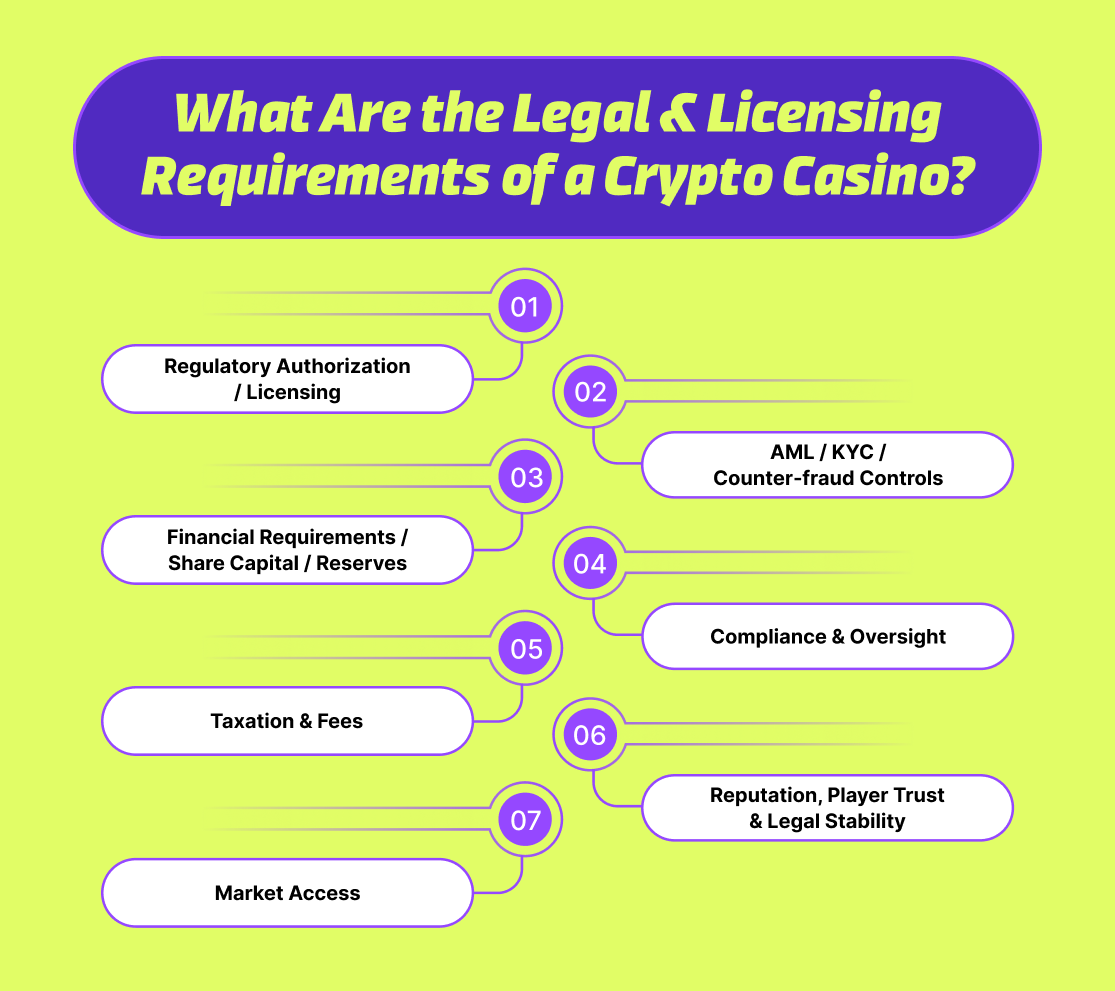
Crypto casinos are more complex than traditional online casinos because of the added layer of cryptocurrency. Some of the typical legal and regulatory licensing requirements include:
Regulatory Authorization / Licensing
You may need a gambling license from a jurisdiction that legally permits online gambling or betting. Additionally, you may need a license or registration as a crypto‑asset service provider, virtual asset service provider, or equivalent, especially under newer frameworks like MiCA in the European Union.
AML / KYC / Counter‑fraud Controls
As per our crypto casino licensing guide 2026, controls related to AML and KYC are important to strengthen identity verification of players, enhance due diligence, transaction monitoring, and thresholds for reporting suspicious transactions.
Financial Requirements / Share Capital / Reserves
Some jurisdictions demand a minimum share capital, escrow accounts, and guarantee funds. Auditing and financial reporting obligations.
Compliance & Oversight
Operators need to maintain compliance with consumer protection, responsible gambling, such as self‑exclusion tools, problem gambling support, and age verification. They can also keep a check on legal requirements via regular audits, compliance with local laws on gambling, cybersecurity, and data protection.
Taxation & Fees
Make sure to know about the best crypto casino license 2026, licensing fees, application fees, and annual renewal fees. Additionally, gather knowledge on gambling revenues, affiliate fees, etc.
Reputation, Player Trust & Legal Stability
Using a recognized regulator helps in attracting players, payment processors, etc. Besides this, in order to maintain legal stability, operators must know about all the laws and regulations to offer players a legal and transparent gambling experience.
Market Access
Whether the license allows operation in key target markets-geographically and demographically. Some licenses are restricted; some of the top jurisdictions crypto casino licenses ban foreign licenses or require local presence. Choose a top crypto gambling license jurisdictions as per the global market access.
Top Jurisdictions for Crypto Casino Licensing in 2026
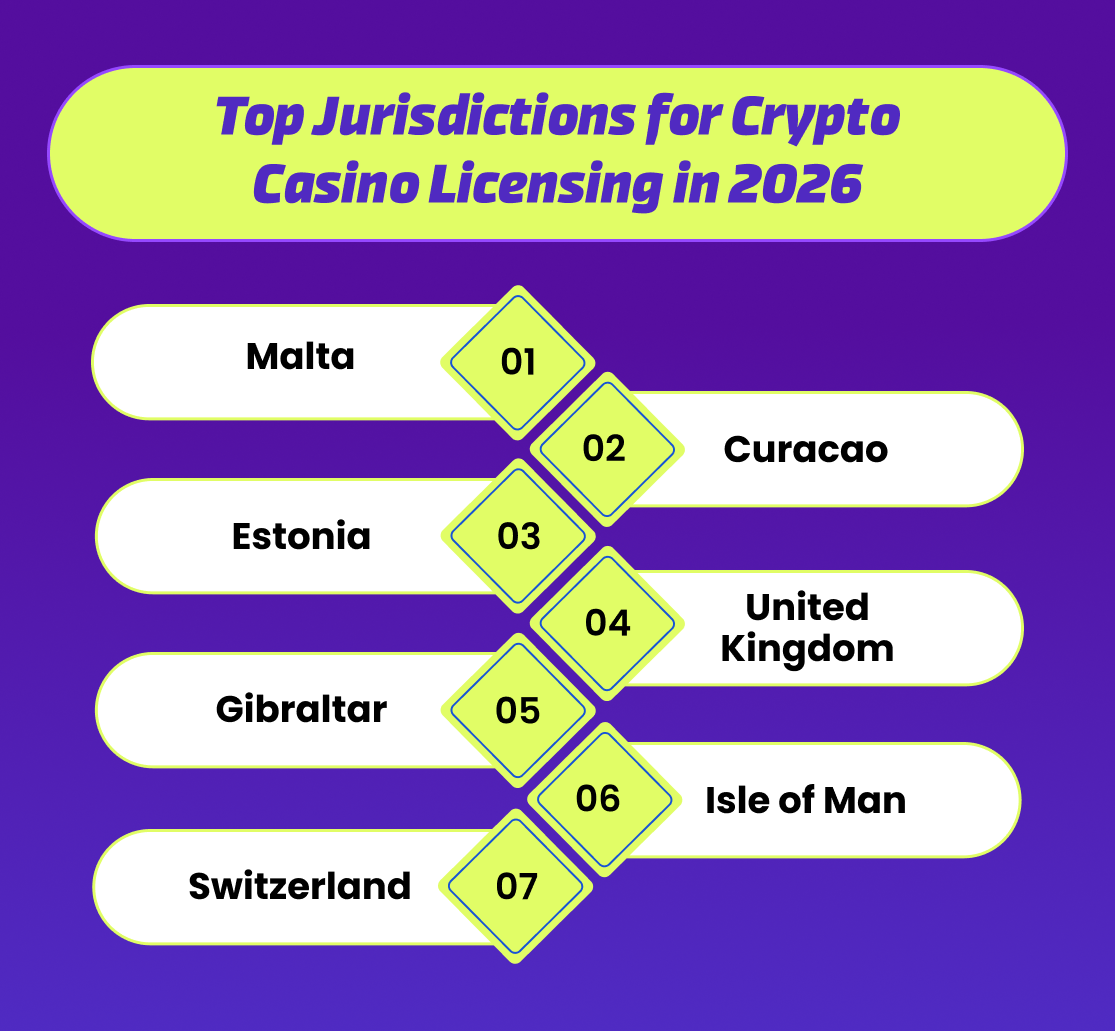
Licensing is the foundation of the crypto casino business, which can make or break the entire venture if not taken care of well. Make sure to do a Bitcoin casino licensing comparison 2026 to get a better understanding.
Based on current regulatory trends, crypto regulation developments, licensing regimes, and attractiveness to operators, these are likely to be among the top crypto casino licensing jurisdictions 2026. Each has pros, cons, and particular features to consider:
| Jurisdiction | Why It’s Strong for Crypto Casinos | Key Strengths | Key Challenges / Considerations |
|---|---|---|---|
| Malta | Malta has long been a leader in iGaming regulation, with its adoption of robust licensing frameworks, strong reputation, and EU access. Crypto-casinos under MGA rules are allowed. |
High reputation among payment processors and players; regulatory clarity; possibility to reach the EU market; well-established oversight and infrastructure. |
Strict compliance (KYC/AML), slower licensing process, higher fees; EU rules like MiCA may add burden; may require physical presence and substantial capital. |
| Curacao | Very popular for crypto gambling owing to lower fees and easier licensing; a license covers many gambling verticals. | Affordable, fast turnaround, lower regulatory overhead; good for startups wanting entry. | Reputation risks; limited legal certainty in certain target markets; payment processors may view burdened risk. |
| Estonia | Estonia is adapting quickly to crypto regulation, including aligning with MiCA in the EU. It has a strong digital infrastructure and relatively business‑friendly policies. | Good regulatory clarity under MiCA; progressive regime; e‑residency or remote presence options; decent tech infrastructure. | Regulatory tightening recently, compliance costs rising; certain license types or activities may need local presence; tax & gambling regulation might still have specific constraints. |
| United Kingdom | The UK Gambling Commission is recognized globally for strong regulation. If a crypto casino complies with its rules, it gains high credibility. | Very trusted by players; strong legal system; high standards; ability to reach the UK market. | Very rigorous compliance; high cost; stricter rules for promotion and marketing; crypto usage may attract additional scrutiny; the UK sometimes changes its regulatory stance. |
| Gibraltar | A well‑known crypto gambling license jurisdictions with a good reputation with high standards. Useful for operators targeting European or British Commonwealth markets. | Credible license, good legal framework, potential tax advantages; robust licensing process ensures trust. | High cost; political/regulatory changes, especially if EU‑UK relations shift, may require physical or substantial presence; crypto‑specific rules may be added or become stricter. |
| Isle of Man | Known for stable, well‑regulated gambling licenses and increasingly open to blockchain innovations. | Good reputation; robust oversight; possibly favorable tax and legal environment; credibility with payment and banking partners. | Cost, slower process, possibly high renewal fees; crypto regulatory status may require additional authorizations; legal complexity. |
| Switzerland | While crypto gambling is restricted in some sense, Switzerland has strong regulation of crypto generally, and very stable legal, financial, and banking systems. | High credibility; strong AML/KYC regimes; good financial infrastructure; stable political & legal environment. | Restrictions on crypto gambling, limited market, compliance and operational costs are high, and payment processor and regulatory approvals may be hard to get. |
What Are the Key Considerations when Choosing a Jurisdiction for Launching a Crypto Casino?
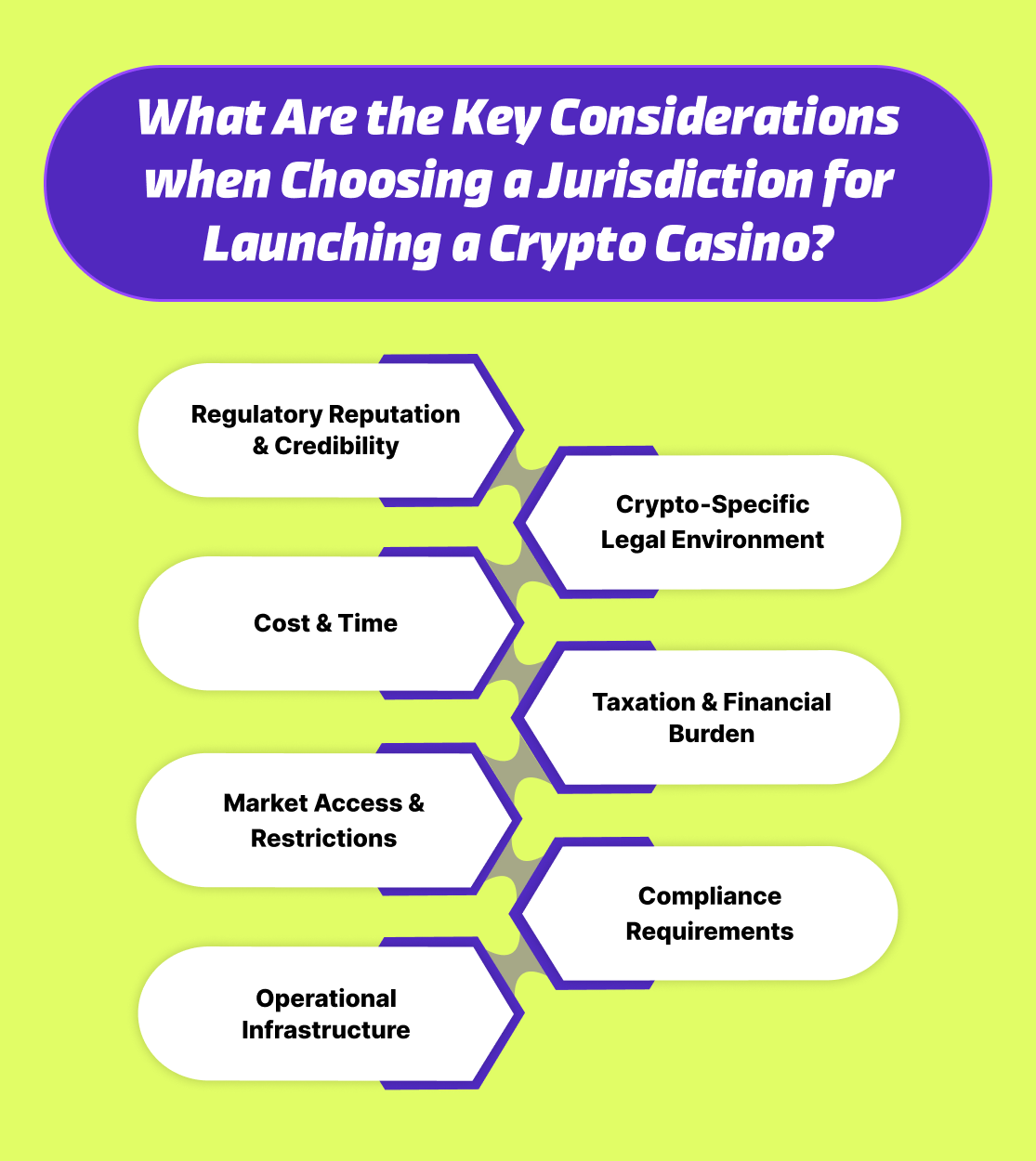
After the bitcoin casino licensing comparison 2026, make sure to consider the key considerations when making a decision. When selecting where to get a license, the following are critical decision factors:
Regulatory Reputation & Credibility
A license from a well‐recognized regulator (e.g., MGA, UKGC) can give trust to players, payment processors, affiliate networks, and banks. A less‑well‐known offshore license may reduce trust or have restrictions in certain markets.
Crypto‑Specific Legal Environment
Pick a jurisdiction that ensures legal requirements and crypto gambling. Are there laws/regulations for crypto service providers? Know whether the provider offers the end-to-end crypto gambling specifications of those crypto gambling license jurisdictions.
Cost & Time
Our crypto casino licensing guide 2026 suggests that licensing fees, renewal fees, minimum capital requirements, time to license, and speed of regulatory approvals vary greatly. Some jurisdictions take months; others may process licenses in weeks.
Taxation & Financial Burden
Make sure to know about the tax rates that apply to gambling revenue, corporate tax, withholding, etc. Additionally, know about crypto profits, hidden fees, and compliance costs.
Market Access & Restrictions
Will your license allow you to serve your target customers? Some top jurisdictions crypto casino licenses may ban or restrict certain markets, e.g., the U.K., U.S., or local markets, even with a foreign license. Geoblocking, localization, etc., may also be relevant.
Compliance Requirements
AML / KYC / responsible gambling/disclosures. Also, requirements for local presence, local directors, physical infrastructure, and servers. Are you prepared to meet tech, security, data privacy, audit, and reporting obligations?
Operational Infrastructure
Banking relationships, payment processors willing to work with crypto, crypto custody solutions, crypto wallet security, server hosting, and ensuring that crypto assets are stored securely.
How GammaPlus Can Help You Get a Legal License for a Crypto Casino?
GammaPlus is a renowned turnkey crypto casino software company that delivers end-to-end turnkey solutions that cater to the needs and expectations of a casino business. With years of experience, knowledge, and expertise in the turnkey crypto casino industry, we offer on-demand customization, low GGR share, and an end-to-end customer support system to offer ready-to-launch crypto casinos. Our team of industrial experts can help you shortlist the ideal jurisdiction for getting the best crypto casino license 2026 for a smooth and hassle-free casino launch.
- On-demand customization
- 24/7 Customer support
- Engaging UI/UX design
- Legal assistance
- Tailor-made turnkey solutions
Frequently Asked Questions (FAQ)
Is crypto gambling legal everywhere?
No. Laws vary greatly across jurisdictions. Some countries explicitly forbid gambling with cryptocurrencies or have ambiguous legal frameworks.
What are the most expensive jurisdictions to get licensed in?
The best crypto casino licensing countries like Malta, Uthe K, Gibraltar, Isle of Man tend to have higher fees, more rigorous compliance requirements, longer timelines, and stricter ongoing oversight.
How long does it typically take to get a license?
Depends on jurisdiction, completeness of documentation, local compliance, etc. For some offshore jurisdictions, it might be several weeks; for more regulated jurisdictions like Malta, the UK, Isle of Man, it could be several months, often 3‑6 months or more.
What are the risks of operating without a proper license or under a weak license?
As per our crypto casino licensing guide 2026, operators may face issues like legal sanctions, fines, reputational damage, difficulty with payment processing, blocked access to markets, problems with players, risk of being shut down, inability to enforce contracts, loss of assets, etc.
Do you offer post-launch services?
Yes. We offer post-launch services like updates, upgrades, and bug-fixing if required.