Integrating crypto payments into an online casino is like offering VIP access at a concert- your players get faster, more flexible entry with exclusive perks.
For more player attraction, engagement, and retention, you should consider integrating cryptocurrencies in your casino to deliver players with authentic and credible gaming experiences. Today’s crypto-savvy users want seamless, borderless, and secure transactions with digital assets like Bitcoin, Ethereum, and stablecoins. The iGaming and online casino sector is no exception. Players are increasingly demanding flexible, secure, and anonymous blockchain payment integration casino options, and regulatory regimes are gradually evolving to allow crypto in more jurisdictions.
For an online casino operator, integrating crypto payments offers many potential advantages: attracting new players, reducing chargeback risks, expanding into geographies with weak or expensive fiat payment infrastructure, offering faster withdrawals, and even leveraging decentralized finance, or blockchain‑based features like wallets, smart contracts, and token rewards. But there are also challenges — regulatory risk, volatility, technical complexity, reputation issues, and ensuring robust security.
In this post, we’ll explore what crypto casino payments mean, how to choose the best crypto payment solution, and a step-by-step guide to integrate crypto payments casino. By the end, you should have a clear roadmap for whether and how to do this well.
What Are Crypto Casino Payments?
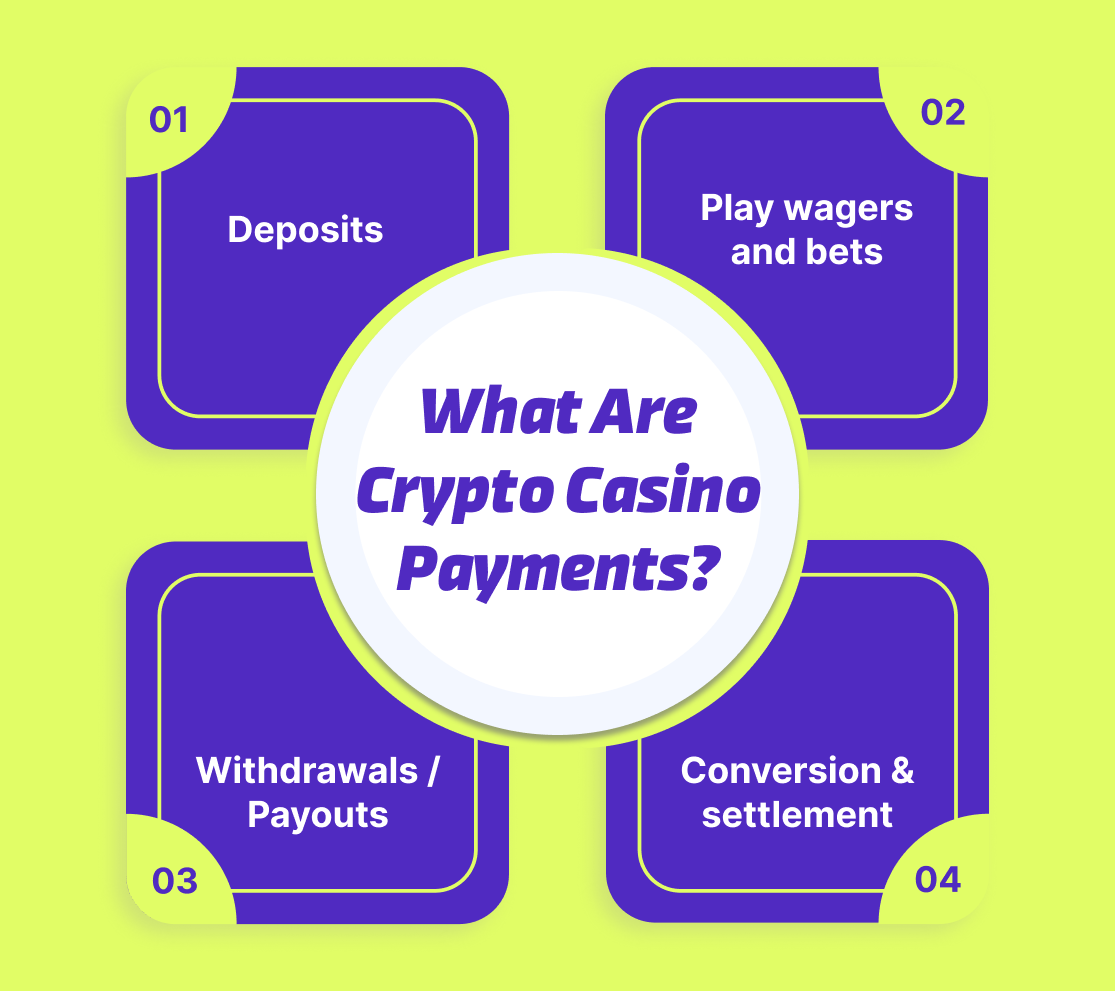
Crypto casino payments are financial transactions involving cryptocurrencies such as Bitcoin, Ethereum, stablecoins like USDT, USDC, or even proprietary tokens, used by casino users to deposit funds, place wagers, receive winnings, or make withdrawals. There are various forms of crypto payment processing casinos:
- Deposits: A player sends cryptocurrency from their wallet to the casino’s wallet or via a crypto payment gateway.
- Play wagers and bets: Some casinos allow direct use of crypto balances or integrate via Web3 wallets like MetaMask, WalletConnect, etc.
- Withdrawals / Payouts: When players cash out, crypto can be sent back to their wallets.
- Conversion & settlement: Because many operators want to minimize exposure to crypto volatility, there’s often a conversion step from crypto into fiat or stablecoins.
Crypto payment integration casino guide suggests some features you may see in modern crypto casino payment systems:
- Support for multiple coins/tokens
- Wallet integration
- Instant or near‑instant settlement
- Automated payout workflows
- Anti‑fraud / AML / KYC compliance
- Smart contract or blockchain‑based verification
How to Choose the Best Crypto Casino Payments Solution?
Choosing a crypto casino payment solution is a time-consuming process and hence requires a lot of research and brand understanding.
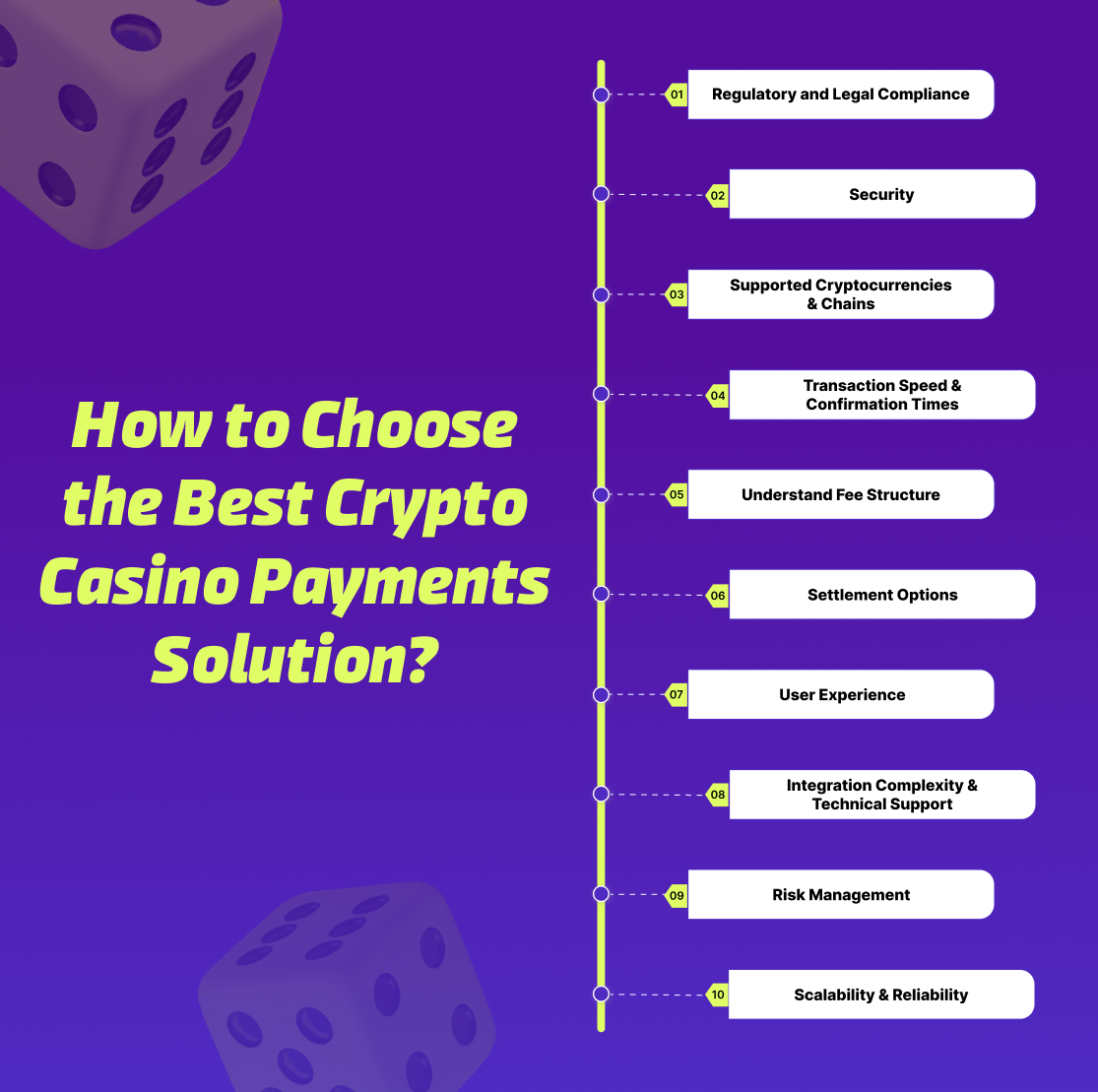
When deciding on a crypto payment provider, gateway, or infrastructure for your casino, you’ll want to evaluate along multiple axes. Here are key considerations:
Regulatory and Legal Compliance
Before cryptocurrency payment casino integration, ensure that crypto gambling is legally permitted in your target jurisdictions. Your provider should comply with AML/KYC laws, hold the necessary licenses, and be registered as a Virtual Asset Service Provider, where applicable. Additionally, check if your gambling or payment operations require separate regulatory approvals in those markets.
Security
Security is foundational; evaluate whether the provider uses custodial or non-custodial wallets, and how private keys are stored. Review encryption standards, smart contract audits, and risk exposure from hot wallets. Fraud detection and real-time transaction monitoring are must-haves to prevent malicious activity.
Supported Cryptocurrencies & Chains
Check whether the provider supports major coins like Bitcoin, Ethereum, and stablecoins, as well as specific blockchains like ERC‑20 or other EVM/non‑EVM chains. While supporting many tokens can expand user reach, it adds complexity, risk, and compliance overhead. Align your coin support with player demand and business strategy.
Transaction Speed & Confirmation Times
Different blockchains have different confirmation speeds, which can impact user experience and operational efficiency. If you’re using a gateway, consider potential delays due to off-chain settlement or internal processing times. Fast confirmation is essential for competitive withdrawal and deposit experiences.
Understand Fee Structure
Understand the full fee structure: network fees, conversion fees, and withdrawal or payout charges. Compare provider fees against base network costs to assess markup and profitability. Transparent fee models are key to maintaining player trust and financial predictability.
Settlement Options
Decide whether you want to hold crypto assets or auto-convert them into fiat or stablecoins upon receipt. This affects your exposure to crypto volatility and treasury operations. Also, review how frequently settlements are processed—daily, weekly, or on demand—to align with your financial controls.
User Experience
Smooth UX is essential to ensure players can easily deposit and withdraw using browser wallets, mobile wallets, or QR codes. The user interface of blockchain payment integration casino should be intuitive, responsive, and clearly display fees and transaction times. A seamless, transparent payment flow boosts conversion and player satisfaction.
Integration Complexity & Technical Support
Evaluate how easily the solution can be integrated using APIs, SDKs, plugins, or webhooks. Good providers offer clear documentation, developer support, and sandbox environments for testing. Ensure compatibility with your casino’s backend, accounting tools, and front-end UI for smoother deployment.
Risk Management
Crypto brings unique risks to manage volatility through stablecoin conversion or instant settlement to fiat. Build strong safeguards against fraud and money laundering with AML-compliant tools. Also consider jurisdictional reputation risks, especially where crypto gambling is restricted.
Scalability & Reliability
Ensure the crypto payment solution can scale with your platform’s transaction volume without latency or downtime. Look for guaranteed uptime SLAs, system redundancy, and disaster recovery protocols. A reliable infrastructure is critical to maintaining player trust and business continuity.
How to Integrate Crypto Payments in Your Casino?
Integrating crypto payments in a casino is a time-consuming process and requires a lot of technical and industry knowledge. You can opt for a crypto payment processing casino software provider, offering the best-in-class and tailor-made cryptocurrency payment casino integration services.
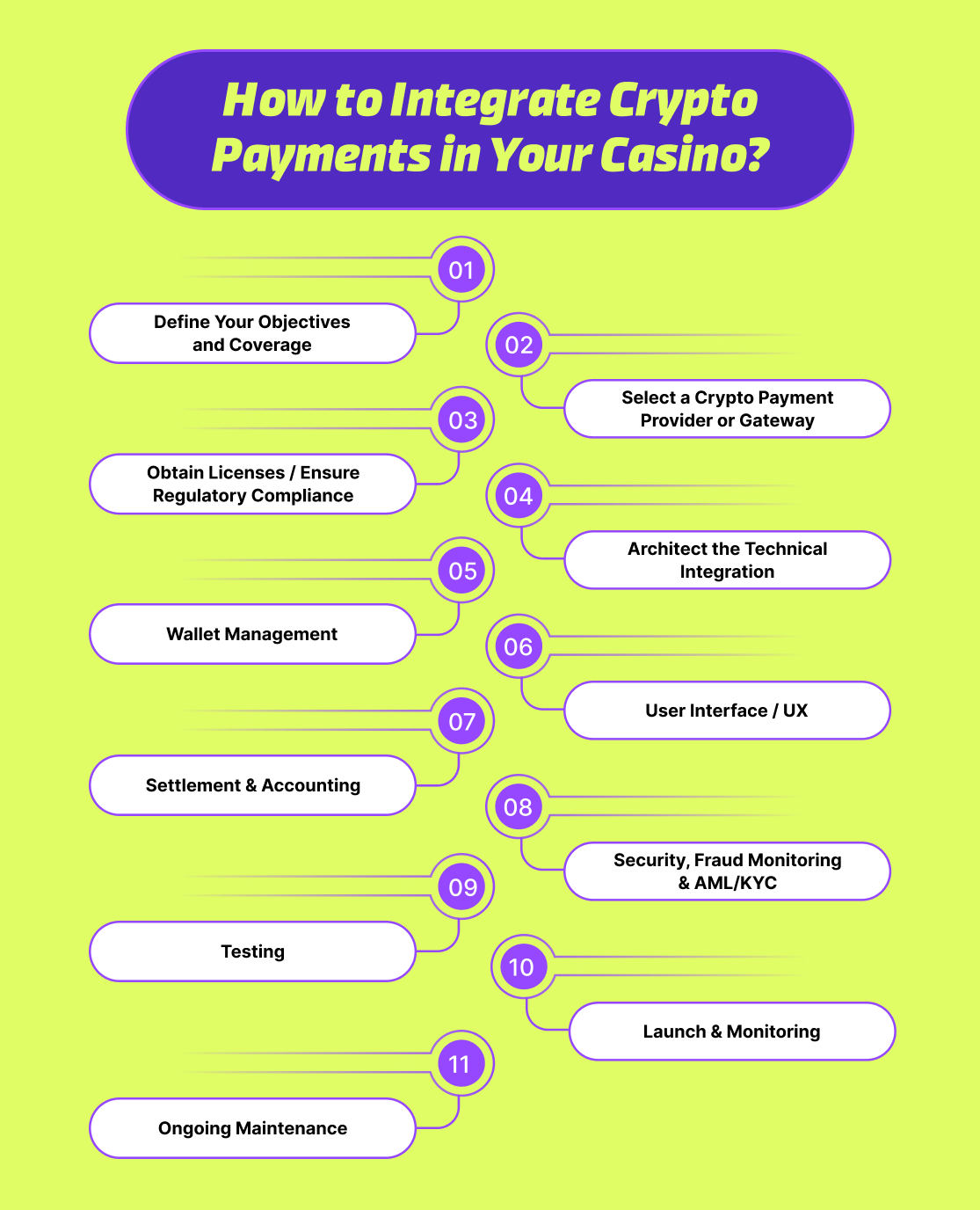
How to integrate crypto payments casino? Here is the list of steps that you should follow to integrate cryptocurrency payments into gambling:
Define Your Objectives and Coverage
Begin by identifying which jurisdictions you’ll operate in and researching their legal stance on both crypto payments and online gambling. Decide which cryptocurrencies you’ll support—Bitcoin, Ethereum, stablecoins, or others. Also, determine whether you’ll allow only crypto deposits or also enable withdrawals, and whether you’ll hold crypto or convert it to fiat instantly to avoid volatility.
Select a Crypto Payment Provider or Gateway
Research crypto payment providers that meet your regulatory, technical, and coin support needs. Compare popular providers like B2BinPay, GatewayCrypto, or CPAY based on fees, compliance, blockchain support, and customer service. Choose one that aligns best with your casino’s scale, jurisdictional requirements, and business model.
Obtain Licenses / Ensure Regulatory Compliance
Secure valid gambling licenses for each region you plan to operate in and ensure your provider is VASP-compliant where required. Implement strong AML (Anti-Money Laundering) and KYC (Know Your Customer) policies for player verification. Staying compliant with local crypto and gambling regulations is critical to avoid penalties and shutdowns.
Architect the Technical Integration
Define how funds will move through your blockchain payment integration casino-whether deposits go directly to player wallets or are converted before being credited. Integrate core APIs for deposits, withdrawals, and real-time transaction confirmations using webhooks. This architecture forms the foundation of a seamless, traceable payment experience for players.
Wallet Management
Decide between custodial wallets or non-custodial wallets. Weigh the trade-offs between control and convenience, and consider extra layers like multi-signature wallets, cold storage, and HSMs. Also, determine whether each user gets a unique wallet address or a shared one with a reference tag.
User Interface / UX
Design a clean deposit interface where players can choose their preferred crypto, see real-time fees, and estimate confirmation times. For Web3-savvy users, support wallet connections like MetaMask. On withdrawals, make it easy to enter and confirm wallet addresses, show fees transparently, and communicate expected processing times.
Settlement & Accounting
If converting crypto to fiat, ensure your provider offers automated settlement with banks or stablecoin options. Keep accurate records of deposit timestamps, conversion rates, network fees, and other data for financial reporting and tax audits. Implement logic to freeze exchange rates at the point of deposit or use real-time rates at withdrawal.
Security, Fraud Monitoring & AML/KYC
Deploy KYC verification, especially for high-value accounts and large withdrawal requests. Set up transaction monitoring tools to detect fraud patterns or suspicious activities. Apply daily or weekly limits for unverified users and maintain an alert system for anomalies in user behavior.
Testing
Use a sandbox or staging environment to rigorously test all key flows-deposits, transaction confirmations, gameplay, withdrawals, and edge cases. Simulate failures like blockchain delays, incorrect addresses, or unconfirmed transactions. Testing helps catch critical issues before going live, protecting both your users and platform reputation.
Launch & Monitoring
Start with a soft launch in a limited market or using a small crypto set to reduce risk. Monitor transaction success rates, confirmation times, and player feedback to identify friction points.
Ongoing Maintenance
Stay up to date with blockchain protocol changes, fee fluctuations, or new forks that may affect transactions of the casino crypto payment gateway setup. Monitor evolving bitcoin payment integration casino regulations in your jurisdictions to ensure continuous compliance. Regularly perform security audits and be prepared to expand your crypto offerings as demand grows for more coins or chain support.
Conclusion
By now, you must know how to integrate crypto payments casino. As per our crypto payment integration casino guide, adding crypto payments to your casino can deliver many benefits: lower fees, faster transactions, access to a broader audience, reduced risk of chargebacks, and modern UX. But it’s not without challenges: regulatory complexity, volatility, security, and technical integration work are all important. If you plan cryptocurrency payment casino integration—pick a compliant and secure provider, test well, design a smooth UX, and maintain strong risk controls- a bitcoin payment integration casino can become a strong differentiator and growth lever for your casino business.
Choose GammaPlus to Integrate Crypto Payments in Your Casino
As a best turnkey crypto casino software provider, GammaPlus offers tailored crypto online casino solutions that unlock a secure, scalable, and regulation-ready solution. With robust security protocols like non-custodial wallet options, multi-signature protection, and cold storage, your funds and user data remain safe. The cryptocurrency payment casino integration process is smooth and efficient, allowing you to go live fast. Whether you’re launching a new crypto casino or upgrading your existing one, GammaPlus provides the crypto payment integration casino guide needed to integrate seamless, secure, and compliant crypto payments.
- On-demand customizations
- Tailored casino crypto payment gateway setup
- Creative UI/UX design
- Robust back office system
- End-to-end post-launch service
Frequently Asked Questions (FAQ)
What is a crypto casino?
Crypto casino is an online gambling platform that allows players to play a wide range of casino games like slots, blackjack, roulette, and so on, via cryptocurrencies like Bitcoin, Ethereum, etc. Contact us to integrate cryptocurrency payments gambling set up rapidly.
How long does it take to integrate crypto payments in a casino?
As per the crypto payment integration casino guide, it takes 2 to 3 weeks to integrate crypto payments in a casino that allows operators to launch a cryptocurrency casino in a strategic way.
Is it legal to accept cryptocurrencies in online casinos?
The legality of casino crypto payment gateway setup depends heavily on your jurisdiction. Crypto laws, gambling laws, and financial licensing differ by country/state. Some places explicitly allow crypto in gambling; others ban or restrict it. You must check with legal counsel, ensure you have proper gambling licenses, and that your crypto operations comply with AML / KYC / VASP / virtual asset regulations.
How fast are deposits and withdrawals?
Depends on the coin and chain: Bitcoin payment integration casino can take from a few minutes to tens of minutes, Ethereum similarly, stablecoins depend on the chain, etc. Gateways may also have delays in processing or verifying transactions.
Do you offer post-launch support?
Yes, we offer post-launch support for our casino crypto payment gateway setup, including maintenance like updates, upgrades, and bug-fixing if required.